

Laser-based Headspace Analysis
Sep. 04, 2026
Laser-based Headspace Analysis (HSA) is a non-destructive analytical method used to measure the gas composition and pressure inside sealed pharmaceutical containers. It is widely applied in container closure integrity testing (CCIT), pharmaceutical package development, process monitoring and stability studies.
The technology is particularly suitable for pharmaceutical containers with a controlled headspace, such as lyophilized drug vials, nitrogen-flushed vials and other packages where oxygen concentration, moisture level or internal pressure is a critical quality attribute.
Unlike destructive leak testing methods, laser headspace analysis can evaluate the package without opening or damaging the container, allowing the same sample to be monitored at multiple points during its lifecycle.
Laser-based Headspace Analysis Test Principle
Laser-based headspace analysis uses tunable diode laser absorption spectroscopy (TDLAS). A laser beam at a specific wavelength is directed through the transparent headspace of a sealed container. The targeted gas molecule (e.g., oxygen, water vapour) absorbs the laser light proportionally to its concentration. An intact container shows a stable headspace gas composition over time. If a leak exists, external gases (e.g., air, oxygen) enter the headspace, or internal gases escape – causing a measurable change in gas concentration or partial pressure. This change is detected and interpreted as a container closure integrity failure.
Laser-Based Headspace Analysis for CCIT
One of the most important applications of headspace analysis is pharmaceutical CCIT.
For example, a lyophilized vial may be sealed under vacuum or an inert nitrogen atmosphere. If the container closure system develops a leak, atmospheric gases can gradually enter the package.
Oxygen headspace analysis can monitor this change in oxygen concentration and help determine whether the package continues to maintain the required barrier properties.
The technique can be applied during different stages of the product lifecycle, including:
● Package development
● Closure system evaluation
● Filling and sealing process validation
● Transportation studies
● Stability studies
● Shelf-life monitoring
● Investigation of packaging failures
Laser-based gas headspace analysis is especially valuable when preservation of the package headspace itself is an important product quality requirement.
Suitable Pharmaceutical Packaging
Laser-based Headspace Analysis generally requires the laser beam to pass through the container headspace. The packaging material, optical path and available headspace volume therefore need to be considered during method development.
Typical applications include:
● Pharmaceutical glass vials
● Lyophilized drug vials
● Ampoules
● Prefilled syringes with suitable optical access
● Cartridges
● Other transparent or translucent sealed pharmaceutical containers
USP guidance notes that transparent or translucent packages can be compatible with laser-based gas headspace analysis because they allow transmission of the required electromagnetic radiation.
The suitability of the method should still be evaluated for each specific product-package system.
What Can Headspace Gas Analysis Measure?
Headspace Oxygen Analysis
Headspace oxygen analysis measures oxygen concentration inside a sealed package. It is commonly used for packages filled or closed under nitrogen, vacuum or another controlled atmosphere.
An increase or decrease in oxygen concentration over time may indicate gas ingress or loss of package integrity.
Moisture and Water Vapor Analysis
Laser-based systems can also measure water vapor in the package headspace.
This can be particularly useful for moisture-sensitive pharmaceutical products and lyophilized formulations where excessive moisture ingress may affect product stability.
Headspace Pressure Measurement
For containers sealed under vacuum or reduced pressure, headspace pressure can provide another important indication of packaging performance.
Changes in pressure during storage may indicate gas ingress, closure defects or changes in the container closure system.
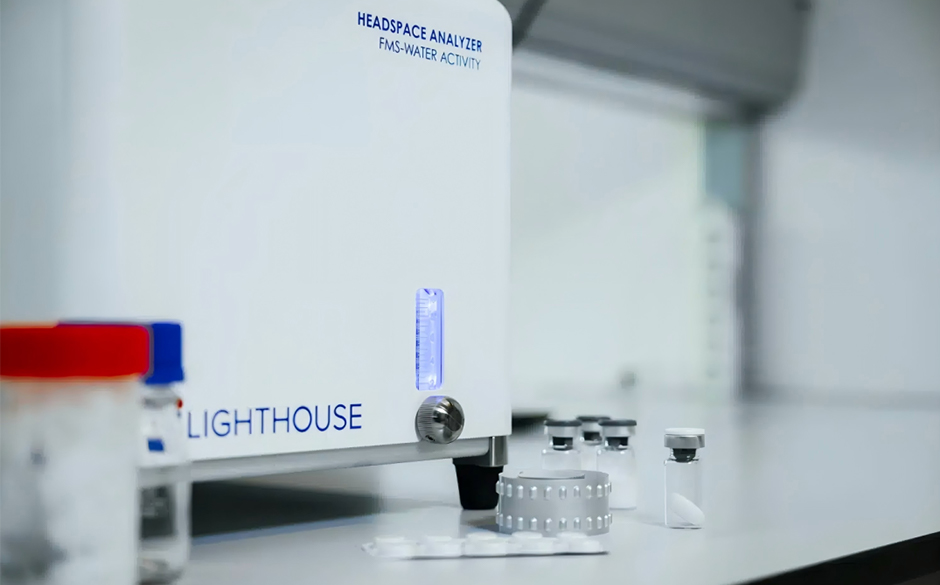
Test Equipments in Our Lab
Lighthouse FMS 760
Regulatory Requirements
USP<1207>
Laser-based headspace analysis is listed as a deterministic leak test method.
Deterministic methods are preferred over probabilistic methods for CCI verification due to their higher sensitivity, objectivity, and reproducibility.
Method validation is required to demonstrate reliable detection of leaks at the product-specific Maximum Allowable Leakage Limit (MALL).
ASTM F2338
Directs to USP <1207> for system-level integrity testing.
Deterministic methods, including headspace gas analysis, are required for CCI assessment of elastomeric closure systems by 1 December 2025.
EU GMP Annex 1
Container closure integrity validation is mandatory for all sterile products.
Headspace analysis is recognised as a validated deterministic method to meet Annex 1 integrity requirements.
Transport and storage conditions must be considered in CCI validation.
Technical Guideline for Packaging System Integrity Study of Chemical Injectables(China)
References USP <1207> and lists laser headspace analysis as an applicable deterministic CCI method.
Recognises two quality requirement categories: (1) maintain sterility/product composition without headspace preservation; (2) maintain sterility, product composition and headspace gas.
Method validation and risk-based method selection are required.
Advantages of Laser-Based Headspace Analysis
Compared with many traditional package integrity tests, Laser-based Headspace Analysis provides several advantages:
● Non-destructive measurement
● Quantitative results
● High repeatability
● No dyes or liquid tracers required
● Suitable for repeated stability measurements
● Measures actual package headspace conditions
● Supports oxygen, moisture and pressure monitoring
● Suitable for laboratory testing and process development
Published research has demonstrated the use of laser-based headspace oxygen measurement for quantitative, non-destructive evaluation of pharmaceutical container closure integrity.
Laser-Based Headspace Analysis at Zholion
Zholion provides pharmaceutical packaging integrity testing and method development support for different container closure systems.
Our laboratory is equipped with the Lighthouse FMS 760 for Laser-based Headspace Analysis and can support evaluation of headspace oxygen, moisture, pressure and container closure integrity according to specific packaging and product requirements.
For a new CCIT project, provide us with your container type, dimensions, fill volume, headspace condition, product characteristics and required detection level. Our technical team can help evaluate whether Laser-based Headspace Analysis is suitable for your application.
Need Help Evaluating Laser-Based Headspace Analysis?
Not sure whether Laser-based Headspace Analysis is suitable for your pharmaceutical packaging?
Send us your container type, package dimensions, headspace conditions, product characteristics and testing requirements. Zholion can help evaluate the appropriate CCIT method and develop a testing solution for your application.
Contact Zholion for Laser-Based Headspace Analysis and CCIT Support.
Related Solutions
-
Jun. 26, 2026
-
Aug. 03, 2026
-
Sep. 04, 2026
-
Sep. 04, 2026
Related Products


